
Sustainable building is the outcome of a design philosophy focused on increasing the efficiency of resource use, energy, water and materials, while reducing a building’s impacts on human health and the environment across its lifecycle, through better siting, design, construction, operation and maintenance. Materials are critical in determining the environmental profile of a building, but they are not the only consideration.
According to research by the Federal Government, buildings are responsible for significant environmental impacts: 30% of the raw materials used, 42% of the energy, 25% of water used, 12% of land use, 40% of atmospheric emissions, 20% of water effluents, 25% of solid waste and 13% of other releases (Australian Federal Department of Industry, Science and Tourism, 1998).
Why materials matter
Materials used in house construction impact on almost every aspect of sustainability, from the raw-resource extraction that scars the physical environment, to non-renewable resource depletion, greenhouse gas emissions through every stage of manufacture and use, and waste that burdens landfill, some of it toxic.
- Raw-resource extraction impacts on the physical environment, for example cutting down tropical forests for window or flooring timbers, or chemical spills from poorly managed mines for metal, paint or ceramic products.
- Non-renewable resource depletion, including oil, and resource quality degradation such as the pollution of water.
- Greenhouse gas emissions from energy production in all stages of material manufacture and use.
- Waste leading to landfill burdens, some of them toxic.
Alongside environmental impacts, which are often hard to locate or quantify precisely, such as the loss of biodiversity and habitat, there can be significant human health impacts. These range from emissions polluting indoor air over many years, to short-term high-level emissions during construction such as painting, through to long-term issues such as groundwater contamination from landfill leachates. Come and visit to learn from how we have constructed our buildings onsite.
Bruce’s Shed: recycled timber
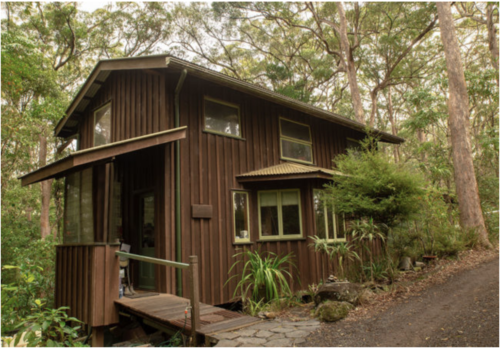
Bruce’s Shed was the first building on the Wild Mountains site, constructed as the starting point for living and working while the ideas and other structures for the environmental education centre evolved. Tallowwood and Yellow Stringybark trees were cut on site in 1988, some milled onsite with a chainsaw and others trucked to the local mill, to construct the mortise and tenon post and beam, its cladding and loft flooring. Secondhand pine was used to line the ceiling. While the building does not perform as a passive solar home, it demonstrates traditional building methods and construction without any power tools, as there was no power on site. Its sustainability lies in its modest scale, low embodied energy, response to the site and a tiny budget. One of the founding families lived here for ten years, and their second son, who was born in the shed, is now an apprentice on the house being built for his parents at Geordies.
Caddie’s: recycled timber
Caddie’s, named in memory of a passionate volunteer at Wild Mountains, is the home for long-term volunteers. Designed as a private home or a cosy shared house for up to four staff members, it was completed in 1998 with a large team of volunteers. Timber inside and out was much of it sourced on site or nearby. The house has a slow-combustion wood stove for cooking and hot water, a composting toilet, and is connected into the water and solar power supply of Wild Mountains. It is oriented to capture northern sun when it reaches through the forest, and the bay window is a favourite sitting spot for residents and visitors. It was built using simple solid timber construction throughout: framing, floors, wall cladding, stair and lining, ceilings and cabinetry.